
Software Engineering
Build coding skills, create portfolio-ready projects, and get personalized career support in a flexible 12-week online format.


Start Date
05/08/2026
Duration
03-06 Months
Experience
None required
Why students choose our Software Engineering bootcamp

- Earn a globally recognized credential from the University of Chicago
- Work on projects grounded in real-world practice
- Get one-on-one support from experienced mentors
- Learn online in a flexible format that fits your life
- Access career coaching, from interview prep to job search strategy

Commitment to quality and growth
Employment rate*
Salary growth*
Launched new careers*
Student population*
*According to the HyperionDev Graduate Outcomes Report. This report combines the student experience from global bootcamp participants, not limited to the university.
Real stories of success

Maria started the bootcamp with a strong academic background but little job experience. The bootcamp helped refine her skills and land a cybersecurity role at an investment bank.

With no prior coding experience, Nabeel joined the bootcamp and discovered a new path in tech. He now builds the infrastructure behind global AI systems.
Student stories reflect experiences from the global HyperionDev learner community and are not specific to University of Chicago participants.
Why pursue a career in software engineering?
Strong career demand
Around 106,100 job openings are projected each year in the US across software development, quality assurance and testing roles.
Competitive salaries
Build skills for a well-paid career, with US software developers earning a median of $135,980 a year.
Work from anywhere
Many engineers work in globally distributed teams, offering the freedom to work from virtually anywhere.
What you'll learn
This program offers a structured path from foundational skills to advanced software engineering practices. As you progress through each level, you’ll build real applications, solve coding challenges, and work on projects that reflect the tasks engineers tackle in professional environments.
Python for Software Engineering
Learn Python fundamentals, including variables, control structures, and data structures like lists and dictionaries. Build your skills with object-oriented programming, recursion, and shell scripting. Use Git and GitHub for version control and collaboration.
Capstones: Investment Calculator, Task Manager App
Introduction to Software Engineering
Design and query relational databases using SQL and SQLite. Build static websites using HTML, CSS, semantic markup, and responsive layouts. Create scalable full-stack applications with Django, integrate testing, and connect external APIs.
Capstones: Relational Database System and Dynamic Django App
Deployment and Development Workflows
Deploy and maintain software using GitHub Pages, Docker, and best practices for documentation.
Capstones: Final Project Deployment with Docker and GitHub
*DISCLAIMER: Curriculum content may be adjusted to reflect industry changes or instructional needs.
Skills with real career impact
Experience, support, and direction to take your next professional step with confidence.
Resume and portfolio review
Craft a polished portfolio and resume that showcases your strengths to employers.
One-on-one mentorship
Get personal guidance on your LinkedIn, interview skills, and career direction.
Global hiring network
Access exclusive job boards, employer events, and valuable industry contacts.
Ongoing guidance
Keep growing with career support and alumni resources after your course ends.
Meet your faculty

Lara Kattan
Clinical Assistant Professor of Operations Management
Lara is a data scientist and machine learning engineer with particular interests in financial modeling and Bayesian financial statistics. At Booth, she teaches Python, SQL, and R courses.
She previously worked as a consultant at McKinsey and EY, specializing in machine learning for finance. Kattan holds an MPP in public policy (econometrics concentration) from the University of Chicago and a BA in economics and political science from Northwestern University.
Potential software engineering career paths
After completing the bootcamp, you’ll be ready for software engineering roles across a range of industries and teams:
Back-End Developer
Build and maintain the server-side systems that power web and mobile applications. Ensure speed, stability, and security behind the scenes.
Junior DevOps Engineer
Support the tools and processes that help development teams ship code efficiently. Focus on automation, testing, and deployment.
Software Engineer
Design, develop, and maintain scalable software solutions. Write clean, effective code that solves business problems.
Systems Analyst
Assess existing systems and workflows. Identify inefficiencies and recommend smarter, more effective solutions.
Ways to manage your tuition
Financial aid and funding options

External resources are available to help you finance your education.*
Review the options below to determine whether you qualify for support toward your tuition
Split your tuition into 3 or 6 monthly installments from $583/month using your existing Visa or Mastercard credit card. No new credit needed.

Pay a deposit, then spread the remaining tuition over 24 monthly installments from $500/month.

Choose flexible monthly repayments from $310/month, with loan options tailored to your eligibility.

Monthly repayments from $25/month, with interest-only or deferred repayment options available.
Use your GI Bill® education benefits to cover your bootcamp tuition. For veterans and eligible family members.
Federal aid may cover your tuition if you are a dislocated worker, low-income adult, or young adult.
*The university provides information about these options for your convenience, but does not endorse or recommend any specific lender or program. We encourage you to carefully review terms and compare options before making any financing decisions.
Earn a software engineering credential upon completion
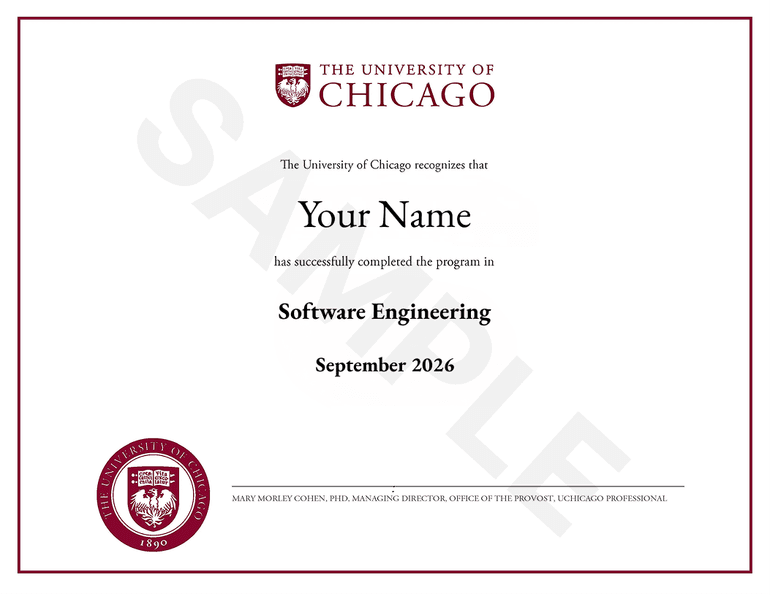
Finish your program with a verified digital credential that validates your achievement and career readiness.

How to apply
Getting started is straightforward. Here's what to expect:
Choose your program
Select the course that aligns with your goals.
Apply online
Complete your application.
Secure your spot
Choose your payment method to continue.
Start learning
Meet your mentor and upskill at your pace.
Complete your course
Finish with a credential that adds value.
FAQ
How do I know if the Software Engineering Bootcamp is right for me?
If you’re interested in learning to code, solving real-world problems with software, or switching to a high-growth tech career, this bootcamp is a great fit. You don’t need prior experience, just a willingness to learn.
Do I need a background in coding or tech to apply?
No prior experience is required. You’ll start with the basics and build your skills step by step, with plenty of support along the way.
Is this bootcamp accredited or certified?
This bootcamp does not carry formal academic credit, but you'll earn a certificate of completion from our institution, which is widely valued by employers and can strengthen your path into a software engineering career.
How much time do I need to commit?
Part-time learners should plan to dedicate an estimated 10–20 hours per week to complete the bootcamp in approximately six months. This option is ideal if you are balancing your studies with work or other commitments.
Full-time learners should plan to dedicate an estimated 35–40 hours per week to complete the bootcamp in approximately three months.
Our online bootcamps are designed to be flexible. If you need additional time, you may have the option to extend your bootcamp duration.
What are the technical requirements?
You’ll need a computer with a stable internet connection. We’ll let you know if any specific tools or software are required before you start.
What if I need to defer or get a refund?
Life happens, and we get that. View our refund and deferral policy or reach out to admissions to talk through your options.
Ready to make your move into software engineering?

In just three to six months, gain the tools and know-how to start working toward a career in software engineering. Thousands have done it, and you can too.